June 30, 2026
Small Talk, or the Organised Fear of Silence
The queue, the lift, the start of a dinner: those moments when you must produce speech about nothing, on pain of letting a silence fall that everyone seems to dread. Some live them as an ordeal and blame themselves for the difficulty. What if it were not small talk that is easy, but small talk that reveals what no one wants to see?
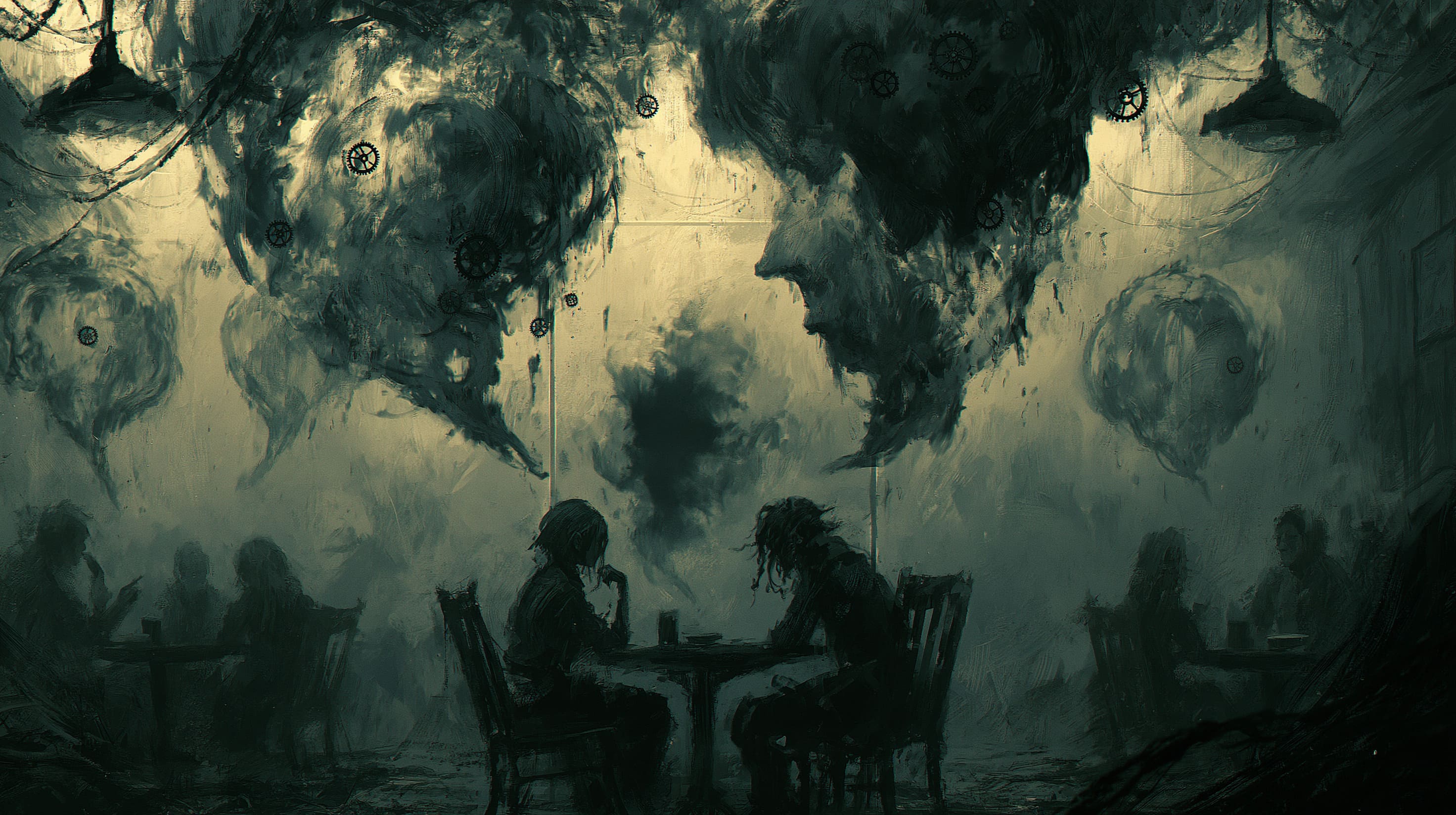
Two things language does
To understand the unease, you first have to untangle what speech accomplishes, for it does two quite different things that a single word covers.
It designates. It says what is, it names, it informs, it commits the one who speaks. And it binds. It maintains the connection between those who speak, it signals belonging, it checks that the channel still holds. These two uses coexist in every exchange, but their proportion varies. In small talk, the second almost entirely outweighs the first. "Lovely weather, isn't it" teaches nothing about the sky. The sentence does not describe the weather; it confirms that we are speaking. The content is the pretext; the bond is the message.
It is this imbalance that throws some people. When you take words seriously, when you expect a question to actually ask for an answer, chatter becomes a strange language, one where sentences say something other than what they state. You look for information where there is only a ritual of presence. You answer the text while others play the melody. The misunderstanding is not a failure of intelligence. It is the gap between two uses of the same language, one of which never declares that it is in play.
Silence turned threat
What remains is the heart of it, which is not the noise of chatter but what it covers: the fear of silence. In an ordinary conversation, a gap is felt as an emergency. Three seconds without speech and a tension already rises, which someone hurries to fill. Small talk is less a taste for speech than a phobia of silence, organised into a genre, handed to everyone as a tacit instruction.
You have to ask why silence frightens us so much. The answer lies in a deep habit: we do not know how to recognise an empty silence. Every silence seems to us a message. A gap in the exchange, and we read into it at once a sulk, a reproach, a calculation, an awkwardness. Since we do not conceive of presence without a message, silence becomes a sign we cannot decode, and therefore a threat. For someone who, on the contrary, lives silence as a rest of meaning, the natural state of speech that has nothing to say for now, that silence announces nothing. It hides no intention. And that is precisely what disturbs: a silence that means nothing but itself abolishes the social game of meaning.
Without putting the talkers on trial
It would be easy, at this point, to despise chatter and those who practise it. That would be a mistake, and an injustice. Small talk is not a baseness. It is an economy, received with one's mother tongue, carried out without awareness, like breathing.
Those sentences that say nothing protect. They cushion the encounter, spare the heavier silences, make bearable the coexistence of people who did not choose one another. The person who asks how you are without waiting for the details of your life is not a hypocrite: they tend the bond as one tends a fire, with small gestures that cost nothing and hold everything. The reproach, if there is one, is not aimed at the talkers. It is aimed at a situation where the bond seems unable to hold otherwise, where shared silence has become so rare that we no longer know how to bear it together.
A clock, or a living speech
We can then ask the question this unease was hiding. If speaking serves only to check that the channel holds, what has become of speech? A language that only synchronises resembles a clock: it marks the time, it confirms that the gears turn together, but it carries no world any more. Words pass from hand to hand and buy nothing.
Those who struggle with small talk are perhaps not behind this language. They are ahead by one demand: that of speech that still says something, that touches true rather than fills the air. This demand costs dearly in social terms, for it refuses the comfort of shared noise. But it keeps open a possibility the age forgets: that a silence may be full, that a rare word may be worth more than a continuous flow, and that being together without speaking is sometimes the highest form of the bond.
The next time a silence falls and panic takes you to fill it, you can remember this. The unease is not in you alone. It is in a culture that has unlearned silence, and that takes for emptiness what could be a rest.