June 30, 2026
Why the World Feels Fake
It is a hard impression to put into words, one many people feel without daring to voice: the sense that something, in the world as it presents itself, rings false. You wonder whether you are turning cynical, or merely tired. But the impression resists. What if it were not the gaze that blurs, but the gaze that sees true?
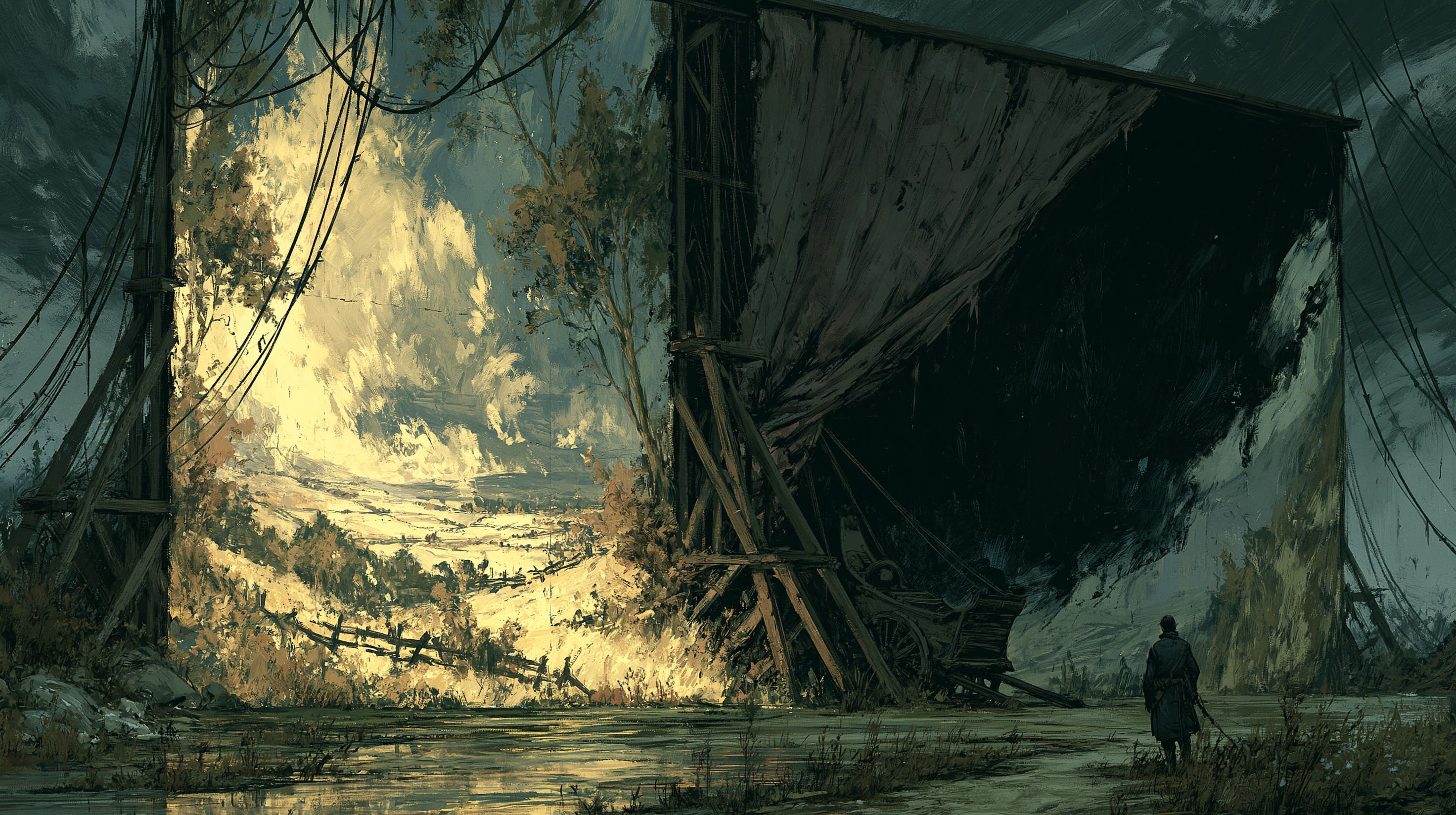
The world turned interface
Something has changed in our relation to the real, and the change is recent on the scale of a life. The world no longer presents itself to us directly. It arrives mediated, subtitled, commented in advance, filtered through screens, images, and the narratives that precede it. We no longer encounter things so much as their representation, carefully composed.
This mediation has a consequence we measure poorly. By dint of living in front of interfaces, we grow used to a world always staged, where every surface has been designed to produce an effect. Raw reality, when it appears, ends up jarring. An unmade-up emotion seems excessive, an unretouched face seems neglected, an uncalibrated remark seems out of place. We have so absorbed the arranged version that the original seems false to us. The reversal is complete: it is no longer artifice that imitates the real, it is the real that no longer resembles the arranged idea we have of it.
When the veil falls
There is a word for the moment when representation stops serving as mediation and becomes total exposure. Some thinkers have called it obscenity, in the first sense: not what offends modesty, but what appears without the veil that made it bearable. Obscenity begins where the veil ends.
The feeling that the world rings false often arises from one of those instants when the veil tears. You suddenly glimpse the mechanism beneath the surface: the convention barely holding, the learned gesture repeating itself, everyone's dependence on a shared fiction no one admits to. What is usually fluid and invisible becomes, for the space of an instant, visible, artificial, almost mechanical. Politeness becomes audible. The set acknowledges itself. And once you have seen that, you can no longer quite not see it. The feeling of fakeness is the price of that involuntary lucidity.
The disappearance of what used to escape
To understand why this feeling has spread, you have to look at what the age has erased. There was a time when the world left margins: chance, silence, moments off-script where nothing was planned or observed. The night was dark, sounds had sources, encounters were not anticipated by an algorithm.
Those margins have closed one by one. Silence has become a product sold to the tired, dimness a privilege. Chance retreats before systems that predict, recommend, optimise. Every moment can be documented, measured, shared. Yet it was in those margins that the real used to breathe, where one could exist without staging oneself. As they vanish, the world becomes a continuous surface, without wings, where everything is presentation. The feeling of fakeness is not a mood. It is the exact perception of a world from which the places where one could be without appearing have been removed.
We are all a little concerned
We often hear, with a deceptive lightness, that we are all a little autistic now. The phrase does not say what it thinks it says. It does not point to a fashion for diagnosis. It confesses something else: that everyone, now, feels something is missing, and that this something was once obvious. A way of being without a role, of existing without an interface, of inhabiting the world without having to justify it at every turn.
Those said to be out of step, those for whom the social theatre was never natural, have perceived this fakeness all along and in its sharpest form. They are, without having wished it, the first witnesses of a world turned spectacle. What many are only beginning to feel, they feel head-on. Their discomfort was not an infirmity in a healthy world. It was the early sign of a world drifting from the real, which the others are now catching up to.
What remains is to know what we do with this lucidity once it has come. It does not send itself back; you do not unlearn how to see the set. But it can stop being only an unease. It can become a demand: to seek, in an age that suppresses them, the rare places where the real still lets itself be inhabited without a mask. The feeling that the world rings false is not the end of a comfortable illusion. It is the start of a question worth keeping open: what would a world be worth that no longer needed so much theatre to bear itself?